Binary options can be traded legally in the United States, but that simple statement needs considerable qualification before someone in New Mexico deposits money with a platform advertising binary trading. The regulated binary contracts available through US market infrastructure are materially different from the offshore fixed-payout products that became heavily promoted online during the 2010s. Both may be based on a yes-or-no proposition about what a market will do by a specified time, but the resemblance becomes weaker once pricing, regulation, settlement and custody of customer funds are considered. For traders in Albuquerque, Santa Fe, Las Cruces or elsewhere in New Mexico, identifying which type of product is being offered matters considerably more than comparing payout percentages or choosing between technical indicators.
A regulated US binary contract operates within the American financial regulatory system. The conventional offshore model normally involves depositing money directly with a foreign website, selecting whether an asset will finish above or below a price and receiving a fixed return if the prediction is correct. In some cases the company running the platform may also be the economic counterparty to the transaction. That means an offshore customer may face two quite separate problems: correctly predicting the market and determining whether the company holding the deposit will price, settle and pay the trade properly. A New Mexico trader using regulated US market infrastructure can still lose because the trade itself was poor. A trader using an unsuitable offshore platform can potentially be right about the market and still have a problem recovering the money.
Binary Options in New Mexico Follow the US Regulatory Structure
New Mexico does not operate a separate binary options market. Residents generally fall under the same federal framework governing these products elsewhere in the United States. The Commodity Futures Trading Commission explains that binary options can legally be traded in the United States when offered through the appropriate regulated market structure. Where commodity-based binary options are offered to ordinary US customers, the relevant contracts generally need to operate through permitted US market infrastructure such as a Designated Contract Market. Depending on how a contract is structured and what sits underneath it, securities regulation can also become relevant, which is why both the CFTC and SEC have published warnings concerning internet-based binary options platforms.
New Mexico provides an additional state-level investor protection framework rather than an alternative to federal requirements. The New Mexico Securities Division states that its primary mission is investor protection and that its responsibilities include licensing securities professionals, reviewing certain investment offerings, investigating violations and pursuing fraud involving investment capital. Its role does not mean a company that is unsuitable under federal rules can become acceptable simply because a customer lives in New Mexico. Nor does a platform become authorised simply because its website accepts an Albuquerque address or New Mexico ZIP code. A registration form proves that the software accepted the information. It says almost nothing about whether the company should be offering that financial product to the person entering it.
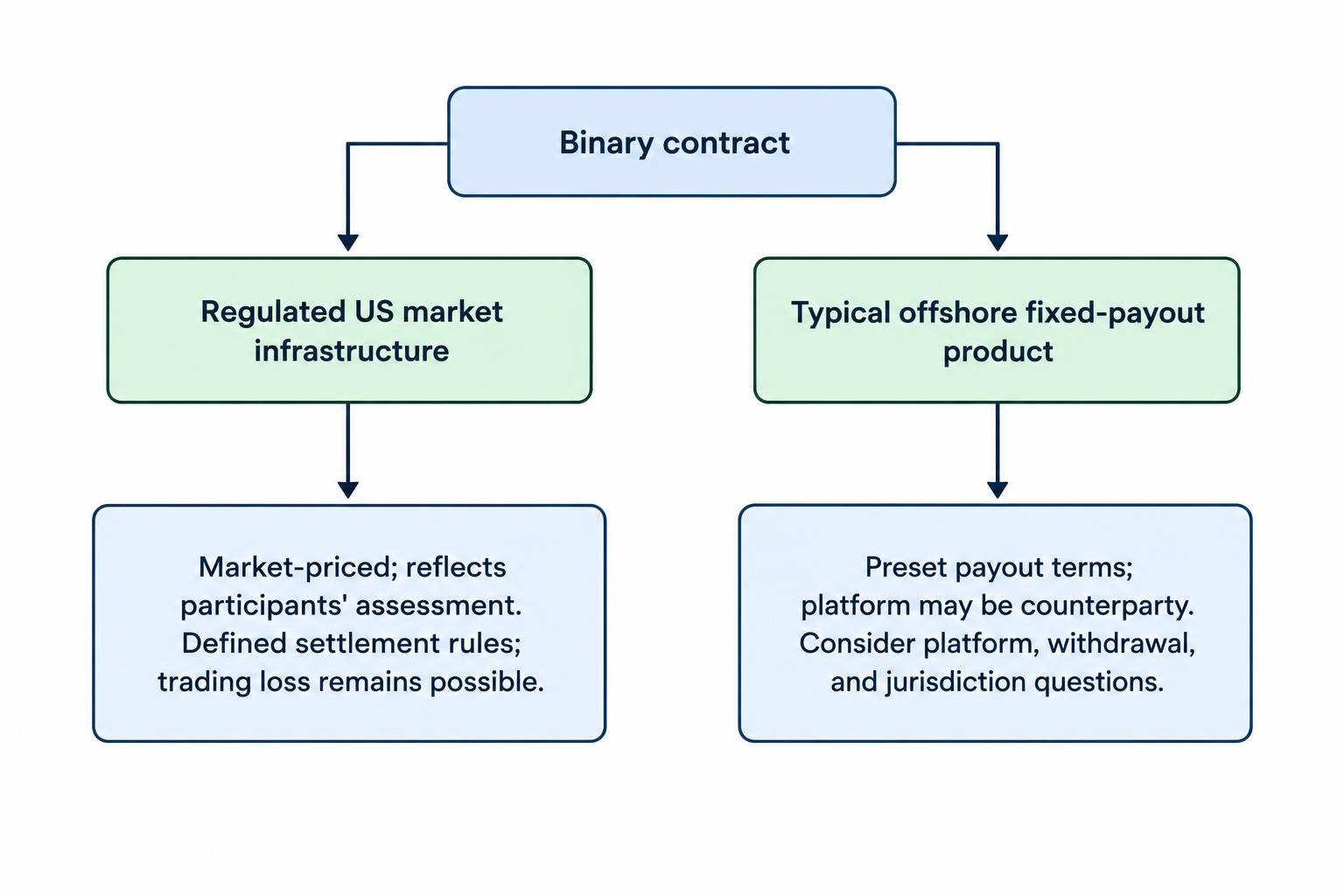
This distinction matters because the phrase binary options is used for products with quite different structures. In a regulated US market, a binary or event-style contract can revolve around a defined proposition with published specifications and predetermined settlement rules. The market price of the contract reflects what participants are prepared to pay for the possible outcome. The familiar offshore retail model works differently. A customer may be asked whether EUR/USD, gold or an equity index will finish above or below a specified level after five minutes, with the platform offering perhaps an 80% return if the prediction succeeds and taking the stake if it fails. Both products produce a binary result, but their economics and counterparty arrangements are not necessarily the same.
That is why comparing regulated US binary contracts directly with conventional offshore binaries can be misleading. The US contract is normally bought or sold at a market price that changes as the perceived probability of the outcome changes. The classic offshore contract normally advertises a predetermined return on the amount risked. One resembles a market-priced probability contract; the other resembles a fixed-return wager against terms set by the platform. That difference changes the mathematics of the trade, but it also changes what a trader needs to investigate before committing money. With a regulated market instrument, much of the due diligence concerns the contract and price. With an offshore product, due diligence must also extend to the company controlling the account.
How Binary Options Are Priced and Why the Payout Matters
Consider a simplified regulated binary contract that settles at either $100 or $0. If the contract is available for $40, the buyer risks approximately $40 for the possibility of receiving $100 at settlement, producing a maximum gross gain of about $60 before fees if the required event occurs. If market participants later consider the event much more likely and the contract trades at $80, the arithmetic changes substantially. A buyer at that price is risking about $80 to make approximately $20. The binary settlement has not changed, but the price paid for access to that settlement has. The contract therefore contains information about the probability the market is assigning to the event, even though the market’s assessment can still prove wrong.
For a trader, this means the problem is not simply predicting whether an event is likely to happen. The trader must decide whether the probability implied by the contract price is too high or too low. Buying a contract at $20 can be sensible if the trader estimates that its real probability of paying $100 is materially higher than the price suggests. Buying the same proposition at $80 demands much greater confidence. This is broadly similar to other forms of financial trading where being directionally correct is insufficient if the entry price already reflects the expected outcome. An asset can rise exactly as anticipated and still be a poor trade if the investor paid far too much for it. Binary contracts compress the same principle into a particularly visible form.
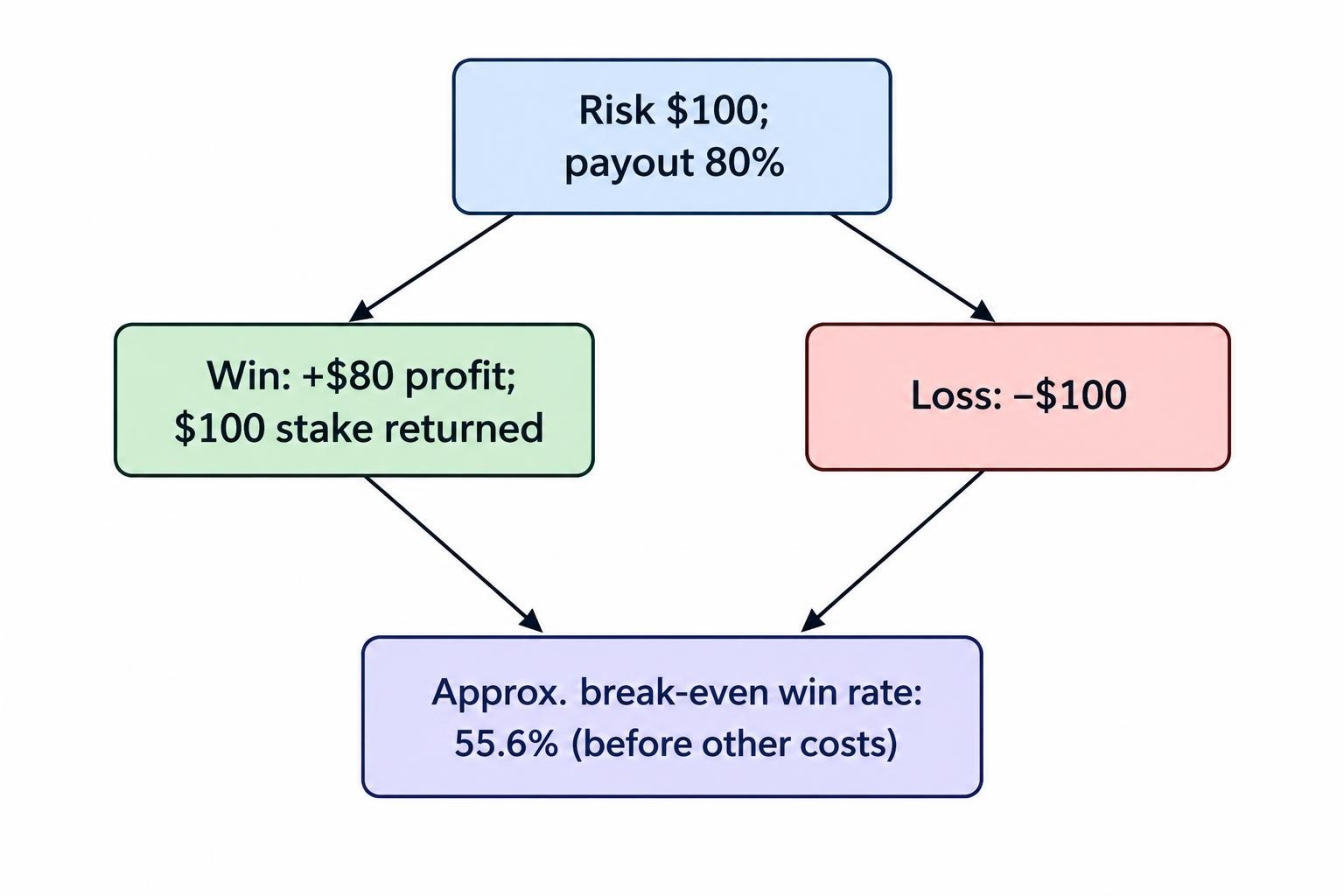
The conventional fixed-payout offshore model produces different arithmetic. Suppose a trader risks $100 on a five-minute EUR/USD binary option offering an 80% payout. If the prediction is correct, the $100 stake is returned and the trader earns $80. If the prediction is wrong, the $100 is lost. Five winning trades therefore produce $400 of profit while five losing trades remove $500. A trader who is correct exactly half the time loses $100 across those ten transactions even before considering any other costs. The problem is not mysterious. Winning and losing trades have different monetary values, so the required win rate must be higher than 50%.
At an 80% payout, the approximate break-even win rate is 55.6%, calculated as 100 divided by 180. At a 70% payout it rises to roughly 58.8%, while at a 60% payout the trader needs to win approximately 62.5% of positions just to reach break-even before other expenses. The SEC discusses this type of negative expected-return structure in its binary options fraud material, noting that losses can outweigh gains where the amount lost on an unsuccessful transaction is larger than the amount earned on a successful one. None of this makes profitable binary trading mathematically impossible. It means that a trader needs an advantage large enough to overcome the payout structure.
A trader winning 65% of positions at an 80% payout would have positive expectancy before transaction costs and operational risks. Across 100 equally sized $100 trades, 65 wins would generate $5,200 in trading profit while 35 losses would remove $3,500, leaving a theoretical $1,700 gain. The hard part is not performing the calculation. It is demonstrating that the 65% win rate represents a repeatable trading advantage rather than a fortunate sample. Winning 13 of 20 trades may feel persuasive, but twenty trades contain very little information about how the method will behave over the next thousand positions, through changing volatility, different market regimes and periods when the assumptions behind the strategy stop working.
This is one reason claims about unusually high win rates deserve scrutiny. A signal service can advertise that it wins 60% of the time without saying anything about the payout attached to the trades, the number of positions in the sample or whether losing calls have been excluded. A reported 55% win rate may sound respectable, yet it loses money at an 80% payout because the approximate break-even level is 55.6%. Even a genuine historical advantage does not prove that the same result will continue. Binary options reward very precise forecasting, and the difference between a profitable and unprofitable method can be only a few percentage points of accuracy.
Short Expiries Make the Forecasting Problem Harder
One reason binary options attract traders is that the outcome is simple. A contract may ask whether the S&P 500, EUR/USD or gold will be above a defined level at a particular moment. That simplicity can be deceptive because the forecast requires both direction and timing. A conventional investor might buy a stock at $50, watch it decline temporarily to $47 and still make money if it later reaches $70. A binary option asking whether the same asset will be above $51 at 10:30 a.m. does not provide that flexibility. If the price is $50.99 at expiry, the contract can lose even if the market rises sharply thirty seconds later.
Very short expiries intensify this problem because increasingly small movements can determine the result. A trader can have a reasonable broader view of the market while repeatedly getting the exact expiry condition wrong. Over a five-minute horizon, normal price noise, spreads, sudden order flow and brief volatility can become more important than the economic argument that originally motivated the trade. A one-minute directional prediction is therefore not simply a six-month investment thesis played at higher speed. It is a different forecasting problem that normally requires different data, different execution assumptions and a far greater sensitivity to timing.
Rapid expiries also allow rapid repetition. A trader can place dozens of transactions during a session, repeatedly exposing the account to the same unfavorable payout arithmetic. This creates a behavioural problem as well as a statistical one. A losing trade can be followed instantly by another attempt to recover the money, then by a larger position intended to recover both losses. The underlying market may barely have changed while the trader’s position size and decision quality change dramatically. A strategy with a modest theoretical edge can be destroyed by uncontrolled staking, while a strategy with no edge can produce a temporarily impressive account curve simply through favorable variance.
Professional trading firms do operate at horizons far shorter than one minute, so short-term trading should not automatically be dismissed as impossible. The difference is the infrastructure behind it. Professional short-horizon strategies are commonly supported by large datasets, execution models, statistical analysis and tightly controlled risk limits. A retail trader reacting to the last few candles is solving a much less sophisticated problem. The relevant question is not whether very short-term forecasting can ever work, but whether the particular trader has evidence that their method produces an advantage after payout terms, execution and normal variation are taken into account.
Offshore Platforms Add Counterparty and Jurisdiction Risk
For someone living in New Mexico, the platform question can matter as much as the trading strategy. An overseas company may happily accept a US address, allow an account to be funded and provide access to binary options. None of those actions establishes that the company is permitted to offer the product to a US retail customer. The CFTC has repeatedly warned about off-exchange binary options businesses targeting US customers and states in its off-exchange binary options guidance that many offshore firms involved in these transactions do not meet US registration requirements. A company can have customers elsewhere in the world, or even hold a licence for activities in another jurisdiction, without being authorised to solicit customers in New Mexico.
This is where international binary options information has to be read with some care. Resources such as BinaryOptions.net can be useful when researching the broader binary options market, terminology, platforms and the way the product operates internationally. A US reader still has to separate general information about binary options from the regulatory position that applies to an American resident. A company may legitimately operate in another country while being unsuitable for someone in New Mexico. Financial websites appear borderless, but the legal entity accepting the deposit, the customer’s residence, the product being sold and the regulator responsible for that activity can all affect whether the arrangement is permitted.
Operating offshore does not by itself prove that a financial company is fraudulent. Many legitimate financial businesses operate internationally and maintain regulated entities in several jurisdictions. The more relevant questions concern which entity is dealing with the customer and what permissions that entity has. If a foreign platform refuses a $15,000 withdrawal, a customer in Santa Fe needs to know which country’s law governs the agreement, where the company is incorporated, which regulator handles complaints, where customer funds are held and whether a judgment or regulatory decision can realistically be enforced against the business. Those issues exist even when nobody is deliberately committing fraud.
The structure of some offshore binary platforms can concentrate considerable power in the company running the website. The same organisation may provide the trading interface, determine the available price feed, establish the expiry condition, control the customer’s account and owe the payout. That arrangement does not prove improper conduct, but it does make counterparty assessment more important. A trader who spends weeks testing RSI settings while spending five minutes investigating the company holding $20,000 has concentrated research effort in the wrong place. A statistical trading advantage has little practical value if the counterparty does not return the resulting profits.
Regulatory concern is based partly on documented complaints rather than simply the speculative nature of the product. The SEC says complaints concerning internet binary options platforms have included failures to credit customer accounts or reimburse funds, identity theft and allegations that software was manipulated to produce losing outcomes. The CFTC has published similar warnings concerning unregistered binary options platforms. This makes it useful to separate several different forms of risk. A trader can lose because the market forecast was wrong, because the settlement price was disputed, because a counterparty failed to meet an obligation or because the business itself was fraudulent. Those are very different events even though all four end with less money in the customer’s account.
Aggressive sales practices create another reason for caution. The traditional offshore binary options industry became associated with account managers who encouraged customers to increase deposits after apparently successful early trading. A person might begin with $500, receive calls offering assistance or supposedly superior trading conditions and gradually be persuaded to transfer several thousand dollars more. Problems could become visible only when the customer attempted to withdraw. US regulators have described complaints in which binary options customers were encouraged to add funds and later encountered cancelled, ignored or refused withdrawal requests. A salesperson whose compensation depends on obtaining additional deposits should not automatically be treated as an independent adviser acting solely in the customer’s interest.
Bonuses can complicate withdrawals as well. Historically, some platforms offered deposit bonuses that increased the displayed account balance but imposed substantial trading-volume requirements before funds could be withdrawn. A customer depositing $1,000 and receiving $500 of promotional credit might discover that accepting the bonus had placed restrictions on access to the original deposit. The CFTC has warned about binary options platforms using bonuses tied to minimum trading volume. This is one reason withdrawal conditions deserve attention before funding rather than after a profitable trading period. Promotional money is rarely economically free; the relevant information is usually in the terms explaining what the customer must do to keep it.
Signals create a different form of risk because they encourage the trader to outsource the forecasting decision. A binary signal may consist of little more than “EUR/USD HIGH, five-minute expiry,” leaving the customer to copy the trade. The apparent advantage is convenience, but verifying whether the signal provider has a genuine statistical edge is difficult. Screenshots of successful positions reveal almost nothing because losing calls can be omitted, old results can be selected selectively and different groups can theoretically receive different recommendations. Meaningful evaluation requires a complete record over a sufficiently large number of trades, together with the payouts available when those trades were issued. A win rate without payout data is not a profitability measure.
How New Mexico Residents Can Assess a Binary Options Platform
The first task is identifying the legal entity that actually receives the customer’s money. A brand name is not enough. Financial websites can operate several companies under one commercial identity, and regulatory permissions can differ between them. The entity listed in the account agreement, funding documentation and terms of business is more important than the logo at the top of the website. Once the company has been identified, a New Mexico customer can investigate its jurisdiction, regulatory status and permission to provide the particular product being advertised. Statements such as “internationally regulated” or “licensed broker” are too vague to answer those questions.
For a company claiming to provide regulated US binary products, the claimed regulatory status should be checked independently rather than accepted because the website displays an official-looking badge. The CFTC provides information about regulated derivatives markets and the National Futures Association maintains its BASIC registration database for relevant firms and individuals. The SEC also directs investors to verify the background and registration status of financial businesses before committing money. Registration checks need to match the exact legal entity, not another company in the same corporate group with a similar name. Fraudulent businesses have sometimes borrowed the identity or registration details of legitimate firms precisely because many customers stop once they recognise a familiar regulator’s name.
New Mexico residents also have a state-level contact when investment activity appears questionable. The New Mexico Securities Division investigates activity falling within its authority and provides a formal process for filing investment complaints. The Division explains that it can review and investigate complaints but cannot promise that lost money will be recovered or act as the customer’s private attorney. That distinction matters. Regulatory action may stop misconduct or support enforcement, but recovering funds that have already been transferred abroad can involve entirely different legal and practical difficulties. Checking the company before the transfer is much easier than attempting to reconstruct its ownership and jurisdiction after a dispute begins.
Withdrawal procedures deserve attention for the same reason. A small successful withdrawal can provide more useful information than pages of marketing copy, although no single withdrawal proves that all future requests will be honoured. Traders should understand verification requirements before funding and notice whether the process changes once they ask for money back. Repeated requests for documents already supplied, unexpected fees, demands for additional deposits or pressure from an account manager to cancel a withdrawal deserve examination. A platform’s ability to accept a card payment within seconds says little about its financial reliability. The revealing part of the process is often what happens when funds are moving back to the customer.
Payout percentages should therefore be considered only after regulation, counterparty and withdrawal questions have been addressed. An offshore platform offering 90% instead of 80% improves the mathematics of an individual binary trade, but it cannot compensate for serious uncertainty about whether the customer can retrieve the account balance. At an 80% payout the approximate break-even win rate is 55.6%. At 85% it falls to about 54.1%, and at 90% it falls to around 52.6%. Those differences matter to a trader with a demonstrated edge, yet none turns a random entry method into a profitable strategy. A five percentage point improvement in payout is of little value if the company owing the payout presents much larger counterparty risk.
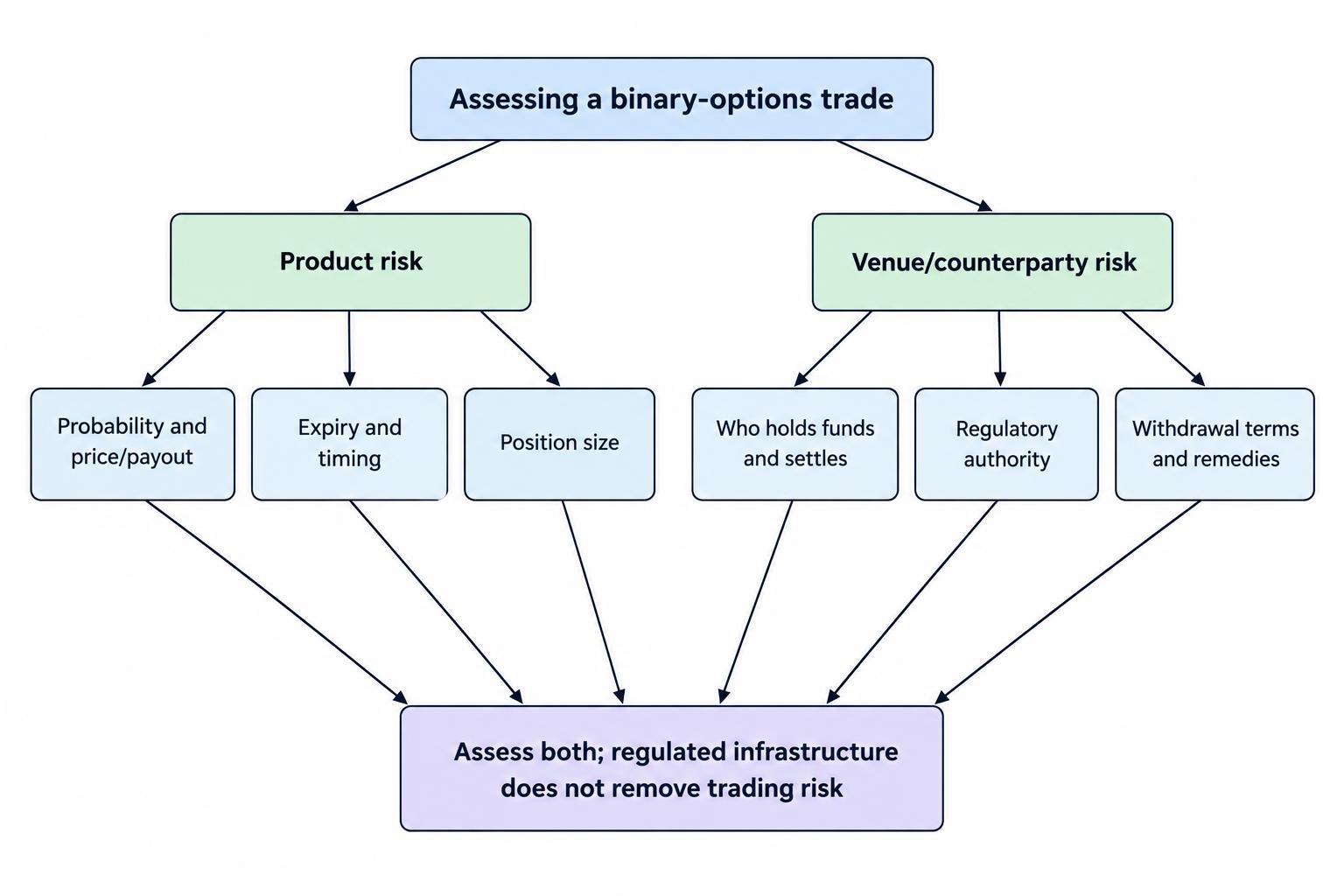
It can help to think about binary options as containing two separate layers of risk. The first comes from the product. The trader has to estimate the probability of the event, determine whether the available price or payout is favorable, choose a suitable expiry and size the position so that a sequence of losses does not damage the account beyond repair. The second layer comes from the venue or counterparty. The trader needs to know who holds the funds, who determines settlement, which regulator has authority, what withdrawal conditions apply and what remedy exists if something goes wrong. Regulated US market infrastructure answers many of the questions in the second group more clearly, but it does nothing to guarantee success with the first.
Can Binary Options Be Traded Profitably?
It would be inaccurate to say that binary options are mathematically impossible to trade profitably. A trader capable of estimating probabilities better than the market or better than the payout structure requires can make money. The principle is the same as in other speculative markets: returns depend on the relationship between probability, price, payoff and risk. If the true probability of success is 60% while a fixed 80% payout requires only about 55.6% to break even, the theoretical expectation is positive. If the trader’s real probability is 52%, the same product has negative expectation regardless of how convincing the recent chart happens to look.
The difficulty lies in establishing the true probability. Traders rarely know it directly. They estimate it from historical data, market behaviour and assumptions that may stop working. A strategy can perform well during a trending currency market and fail once volatility contracts. Another can appear excellent across a few dozen positions because random variation happened to favor it. Binary options make these errors particularly visible because every contract resolves into a clear winning or losing outcome, but the binary result can tempt traders to judge strategies from samples far too small to support the conclusions being drawn.
Position sizing therefore matters even when the strategy appears profitable. A trader risking 20% of the account on each binary contract can suffer severe damage from a short losing streak that is statistically normal for the strategy. A method with a 60% win probability will still produce clusters of losses. Increasing the stake after each loss in an attempt to recover quickly can turn ordinary variance into account failure. The predefined maximum loss of many binary contracts is useful only if the amount allocated to that loss is sensible relative to total capital. Knowing exactly how much can be lost on one position does not make losing half the account across several positions acceptable.
Binary options can therefore appeal to traders who value a defined outcome, predefined risk and a straightforward proposition about whether an event will occur. Those characteristics do not make the product simple to trade profitably. Two possible settlement outcomes are not the same thing as a 50% chance of making money. The market price or payout determines what level of forecasting accuracy is required, while expiry timing determines how precisely the forecast has to be right. The apparent simplicity of the contract can conceal a demanding probability problem.
Binary Options in NM Begin With Knowing Which Market You Are Entering
For a New Mexico resident, the most important distinction is not between one indicator and another or between an 80% and 85% advertised payout. It is between binary contracts operating through regulated US market infrastructure and the conventional fixed-payout OTC products commonly associated with offshore binary options websites. The regulated structure does not prevent trading losses, but it substantially changes the regulatory, settlement and counterparty framework surrounding the transaction. An offshore arrangement can introduce additional questions about jurisdiction, withdrawals, pricing and whether the company is permitted to solicit a US customer at all.
That does not mean every offshore financial business is fraudulent, nor does it mean every binary options trader loses money. Some traders can develop a genuine statistical advantage. The problem is that trading skill addresses only one part of the risk. A profitable strategy cannot repair a weak counterparty, an unlawful offering or an inaccessible account balance. For that reason, New Mexico traders should investigate the venue before spending much time optimising the strategy. The sequence matters: establish what product is being offered, identify who is offering it, verify whether the arrangement is appropriate for a US resident and only then decide whether the contract itself offers a worthwhile trading opportunity.
Binary options are often marketed around speed and simplicity, but a sensible assessment points in the opposite direction. The contract may settle with a simple yes or no, yet reaching that settlement involves probability, pricing, timing, capital management and, in some cases, substantial counterparty analysis. A New Mexico trader considering the product therefore needs to answer two questions before placing money at risk. The first is whether the probability and payout make the trade worthwhile. The second is equally important: who exactly is responsible for paying if the trade succeeds?